Australian Internet Loans Bike Loan Repayment Calculator
Calculate motorcycle loan repayments in seconds with our Bike Loan Calculator. Compare finance options and plan your ride with confidence.
Calculator results are estimates only and not quotes. Actual quotes will be provided by licensed brokers after you submit an enquiry.
Bike Loan Details:
Important!
Bike Loan Interest Rates differ from lender to lender and will depend on your individual circumstances (credit history, employment status, age, etc.). To find out if you qualify ... and for a free, personalised interest rate and repayment quote,
please CLICK HERE
Bike Loan Amortisation Calculator
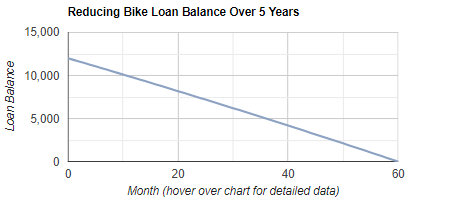
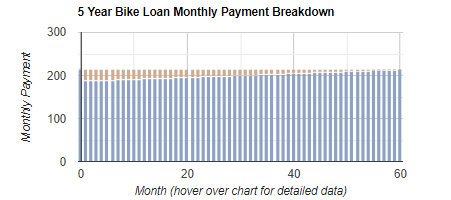
The following amortisation graphs detail month-by-month data on the progress of the proposed loan. The first chart below examines the reducing loan balance over the course of the finance contract term. The second graph illustrates the portion of each monthly repayment allocated to payment of interest vs principal reduction.
How to use our Bike Loan Repayment Calculator
Our Bike Loan Repayment Calculator is designed to estimate your motorcycle loan repayments in seconds, so you can compare bike finance options and plan your budget before you commit. It is important because small changes to loan size, term length and interest rate can materially change your monthly repayment and the total interest you pay over the life of the loan.
This calculator provides estimates only and is not personal financial advice. Results do not take into account your objectives, financial situation or needs. Interest rates and fees vary by lender and your individual circumstances, and your final rate can only be confirmed after an application is assessed.
How to complete the form for the best result:
1. Purchase Price
Enter the bike purchase price as a whole number (no dots or commas). If you expect to borrow extra for on-road costs such as stamp duty, registration or insurance, include those amounts in the figure you enter so the estimate better reflects your likely loan amount.
2. Deposit or Trade-in Value (if applicable)
Enter your deposit or trade-in value as a whole number. If you have no deposit, enter 0. A higher deposit generally reduces the amount borrowed and can reduce interest paid over time.
3. Term of Loan (Years)
Select a term between 1 and 7 years. Longer terms typically reduce monthly repayments but can increase the overall cost of the loan due to more interest over time. Choose a term that fits your cash flow, not just the lowest repayment.
4. Interest Rate (% per annum)
Select an interest rate for the simulation. If you are unsure, test a conservative higher rate to see whether repayments remain affordable.
5. Calculate
Click calculate to generate your estimated repayment and amortisation visuals.
How to interpret the results:
1. Repayment estimate
Use the repayment figure as a starting point for budgeting, then stress-test by increasing the rate or reducing your deposit to see how sensitive repayments are.
2. Amortisation graphs
Review the loan balance chart to understand how quickly you reduce what you owe, and the interest versus principal chart to see how much of each repayment goes to interest compared with reducing the loan balance over time.
Recent vehicle finance commentary has put balloon and residual payments back in the spotlight, particularly for Australians considering cars, utes, vans, trucks or business equipment. The issue is not that balloon structures are inherently unsuitable. Used carefully, they can help borrowers manage cash flow by lowering regular repayments. The risk is that the smaller monthly figure can distract from the larger amount still payable at the end of the loan or lease term. - read more
Recent lending market coverage points to a more competitive spring for Australian borrowers, with some banks and non-bank lenders adjusting selected fixed and variable loan offers. The shift does not mean borrowing has suddenly become easy or cheap, but it does suggest lenders are again competing harder for well-prepared applicants with stable income, clean repayment histories and clear loan purposes. - read more
Recent small business lending commentary points to a continuing change in how Australian lenders are assessing finance requests: the focus is moving beyond annual accounts and into the day-to-day health of cash flow. For business owners seeking working capital, vehicle finance, equipment upgrades or short-term funding, that means bank statements, tax position and repayment conduct are becoming central to the conversation. - read more
Applying for an online loan can be a convenient way to manage your finances from the comfort of your own home. With technology's advancement, borrowing money has shifted from traditional brick-and-mortar institutions to digital platforms, making the process quicker and more accessible. However, navigating through this online landscape requires an understanding of how it operates. - read more
Preparing for business finance is easier when you know what lenders commonly check. This guide explains the documents, eligibility factors and practical preparation steps Australian business owners, sole traders and self-employed applicants may need before applying. - read more
In the financial landscape of Australia, credit scores stand as a crucial measure of one's financial health and credibility. A credit score, essentially a numerical representation of your creditworthiness, is used by lenders and financial institutions to determine the risk involved in lending to you. This score can range from 0 to 1200, where higher scores signify better credit health and an increased likelihood of securing loans with favorable terms. - read more